Industrial Seduction and the Systematic Stripping of Creative Agency in High-Growth Environments.
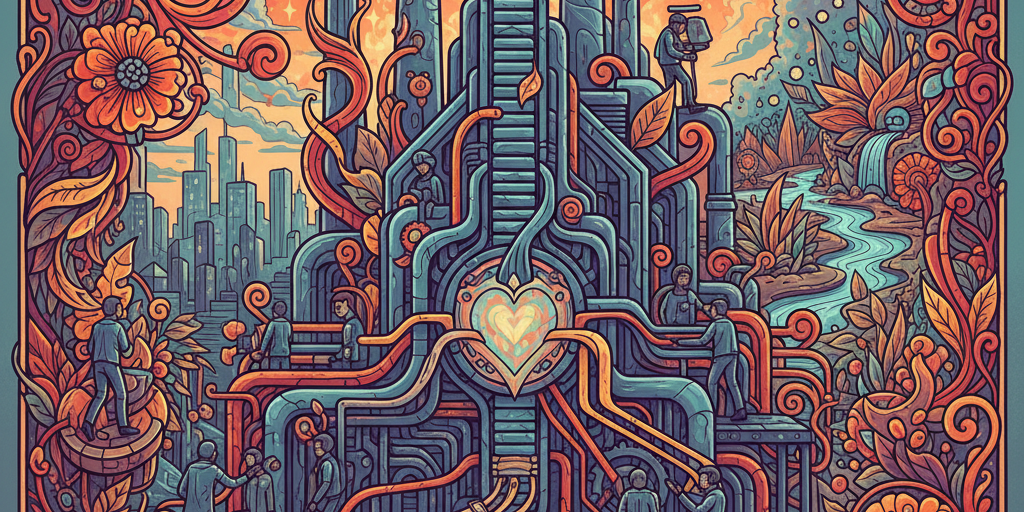
Efficiency is a seductive trap that turns craftspeople into interchangeable parts. To scale without losing your soul, you must stop being the engine and start being the architect of a self-governing organism.
Are you actually building a company, or are you just fueling a machine with your own nervous system?
What are you willing to sacrifice for a 10% gain in throughput: your team’s discretion, your best people’s craft, or the company’s capacity to adapt?
What if the very systems that made your work possible are silently stealing its soul?
The Industrial Seduction
We have been seduced by the promise of industrialism. We crave the efficiency and convenience that comes when management steps in to productise, routinise, and optimise every workflow. It offers huge productivity gains, but it creates a business that is surprisingly brittle. By prioritising "any colour you want, as long as it's black," we strip the humanity and flexibility out of the work.
The grit and instinct that helped you launch are now the very things slowing you down. If your team is stuck waiting on you for every decision, you aren't leading. You are powering the operation with your own stress.
You tell yourself you’ll fix the structure once the company gets bigger, but that "someday" keeps getting pushed to the next quarter. You remain trapped in the weeds, and your momentum plateaus because you are playing by old, industrial rules in a world that demands agility.
Most organisations have learned to prize one thing above all: squeeze more output with fewer moving parts. Standardise the task, hard-code the handoff, and make onboarding a two-hour checkbox. That industrial instinct (efficiency first, convenience second) produces astounding productivity gains. It also makes the system brittle.
Craftspeople become replaceable roles, customers get smoother but thinner experiences, and subtle capabilities (the backyard expertise, the freelance editor’s judgment, the chef’s touch) are eroded into processes that can be swapped like parts.
At the same time, leaders expect flexible devotion from people when business needs spike, while assuming the baseline arrangement will absorb these swings. When that implicit balance breaks, fairness unravels and relationships strain.
From Ritual to Routine
You’ve built a thriving practice. Whether it’s a backyard garden, a freelance editing studio, or a kitchen where every dish tells a story. Efficiency and convenience have turned those passions into profit, but the moment a manager steps in, the process becomes a machine.
Routines replace rituals, metrics replace meaning, and every nuance that gave your work its humanity is flattened into a single, repeatable step. The promise of industrial‑scale productivity feels sweet, yet it leaves you with brittle workflows, vendor lock‑ins, and a loss of creative freedom.
The Psychological Flare
This isn't just an operational bottleneck. It is an emotional crisis. Those frustrations you feel toward your team, judging them as "needy" for asking questions or "disorganised" for missing details, are actually flares warning of a deeper issue. As the "town jester," these triggers are mirrors reflecting your own blind spots.
That judgment of a coworker's anxiety might actually be masking your own fear of losing control. Your annoyance at their "entitlement" could be covering your own shame about wanting more than you think you deserve.
If you don't face these blind spots, the emotions you try to avoid will continue to unconsciously drive your decisions. You will keep paying for the business’s survival with your peace of mind, leading to a breakdown where the cost of the relationship is no longer sustainable for anyone involved.
The High Cost of Control
This is not only a design problem. It’s a slow bleed. Creativity narrows as practice is boxed into KPIs. Talent leaves not for more money but for work that lets them matter. Founders who never stop approving decisions become chokepoints: momentum stalls behind a single nervous system.
Hidden costs show up as quiet judgments: the resentment you mask as “too expensive,” the low-grade shame when someone else gets credit for your craft. Those judgments are flares: they point to inner fears and policy blind spots. Left unchecked, the business becomes efficient at delivering yesterday’s product and catastrophically slow at inventing tomorrow’s.
Each day the “industrial” layer tightens: staff are swapped like interchangeable parts, colours are forced to stay black, and the cost of deviation skyrockets. Employees who once took pride in craftsmanship now watch their joy erode, while leaders spend endless hours fielding micro‑decisions that should have been delegated.
The hidden toll isn’t just slower growth, it’s burnout, disengagement, and a culture that can’t adapt when the market shifts. The longer this rigidity persists, the more the original spark dims, and the harder it becomes to reignite genuine value.
The Philosophical Pivot
The way out requires a profound shift in perspective. It's a willingness to dive down the "rabbithole" until a clear, 360-degree picture emerges. We must look to the thinkers of the past, like Stewart Brand or Ram Dass, to understand what it means to live and work thoughtfully, while simultaneously hunting for smart new business models that solve actual problems.
We need to break the standard molds. Just as the speaking industry realised that a 10-minute "pop-in" can sometimes offer more value than a rigid hour-long keynote, we must design structures that deliver value exactly where it is needed.
This includes redefining the economic relationship between company and team. We must establish a clear quid pro quo where above-normal work is rewarded and the give-and-take balances out over time. It’s about creating a system that is measured, financially viable, and adaptable when needs change on a sustained basis.
This is solvable, not by rejecting productivity, but by redesigning where and how it applies. Start with ruthless mapping: which activities truly benefit from industrialisation, and which demand retained craft?
Pair that map with clear, humane compensation conventions: a measured quid pro quo where above-normal contributions are rewarded and below-normal performance is corrected, but where one-off swings are handled with flexible credits rather than opaque grudges.
Commit to structured deep dives with room for disciplined rabbit-hole work that surfaces new business models and micro-products (short, high-value engagements rather than only hour-long monoliths).
Finally, build decision rights and automations so the leader can lead strategy, not sign every email. Use honest emotional work as a tool: treat harsh judgments from the team as data to discover what unaddressed anxieties or misaligned incentives are actually driving behaviour.
The Architect’s Framework
Imagine stepping back into the mindset of the 1960s visionaries like Stewart Brand’s 10,000‑year clock, Buckminster Fuller’s holistic designs, or the “pop‑in” model that reshapes speaking engagements into bite‑sized bursts of impact.
By treating each workflow as a “rabbithole” worth exploring, you surface a 360° view of the problem and discover a flexible framework that balances efficiency with humanity.
The secret weapon? A system that lets you pay for work proportionally, honouring the ebb and flow of effort while granting autonomy to act without constant oversight. It mirrors the jester’s truth‑telling, exposing emotional blind spots that keep teams stuck, and replaces the owner’s nervous‑system‑powered decision loop with self‑governing processes.
Designing for Fierce Grace
When you implement systems that can think and move without your constant intervention, you reclaim the artistry of the work. You move away from cold industrialisation and back toward the "backyard garden" approach where value is created with care, but scalable through smart design.
You will stop hovering over the "exact ebbs and flows" of daily tasks and start building an organisation that possesses "fierce grace." This is your opportunity to stop being the engine and start being the architect.
Imagine a firm that scales throughput without flattening craft. Teams make day-to-day calls; leaders shape direction. Compensation is predictable and adjustable. People trust the trade.
The rhythm of efficiency hums beneath, but each instrument retains its unique timbre. Teams make decisions independently, vendors integrate seamlessly, and creativity flourishes alongside scalable systems.
The result is a resilient organisation that grows without sacrificing the soul of its founders. New offers emerge from purposeful deep work, including short, targeted products that fit real customer needs. The organisation stops being a factory run by one nervous system and becomes a resilient organism that learns.
Begin with the smallest experiment that exposes whether you’re optimising the right thing. Do that, and you’ll find out fast whether your systems serve people or only efficiency.
Ready to reclaim the heart of your work while scaling intelligently? Where are you being the bottleneck?
Start by mapping one repetitive process, assign clear value exchange rules, and give your team the autonomy to iterate and build the system. Watch the friction dissolve, the energy rise, and the future you’ve imagined become inevitable.
Three concrete moves to start today:
1. Pick one workflow and decide to industrialise it completely, or protect it as craft; document why.
2. Draft a simple compensation rule: “extra > X hours = credit or payout within 30 days”; test it for a quarter.
3. Reserve one quarterly slot for a focused deep dive to prototype a short-format product or service (a 10–15 minute expert pop-in, a micro-course, a consultation template).
The Essential Concepts
From Engine to Architect
The primary failure of the "Industrial Seduction" is that it convinces founders they must be the engine of the operation. If every decision, from a marketing email to a vendor contract, must pass through you, you are powering the company with your own stress.
- The Seductive Trap: Standardising, routinising, and optimising feels like progress. It offers immediate throughput gains but strips out the flexibility and craft required to adapt to a changing market.
- The Brittle Machine: A system where "any color is fine as long as it's black" is efficient at delivering yesterday’s product but catastrophically slow at inventing tomorrow’s.
- The Founder Chokepoint: Growth plateaus because momentum is limited by the bandwidth of one person. You become the bottleneck for the very thing you are trying to scale.
The Psychological Flare: Frustration as Data
When you find yourself judging your team as "needy" or "disorganised," you aren't seeing them clearly; you are seeing a flare. These frustrations are mirrors reflecting your own internal blind spots.
- Projection of Control: Your judgment of a coworker's anxiety is often a mask for your own fear of losing control.
- The Unconscious Drive: If you don't face these emotional triggers, you will continue to pay for the business’s survival with your own peace of mind.
- The "Town Jester" Perspective: Use your irritations as data points to identify where incentives are misaligned or where you have failed to provide a clear framework for autonomy.
The Philosophical Pivot: Designing "Fierce Grace"
To reclaim your agency, you must shift from cold industrialisation to a model of "Fierce Grace." This involves a 360-degree view of the problem that balances scalability with the soul of a "backyard garden."
The Architect’s Map
- Ruthless Mapping: Distinguish between activities that must be industrialised for scale and those that must be protected as "craft."
- The New Quid Pro Quo: Establish clear, humane compensation rules. If a team member works extra hours to meet a spike, there must be a predictable credit or payout system that avoids "opaque grudges."
- Micro-Product Innovation: Break the mold of monolithic services. Design "pop-in" models or high-value, short-format engagements that solve real problems without requiring massive overhead.
The "Architect’s Framework" Action Plan
You can begin transitioning from the engine to the architect today by implementing these three concrete moves:
- The Industrial vs. Craft Audit: Pick one workflow in your company. Decide today: Is this a "machine" task that should be fully automated/standardised, or is it a "craft" task that requires human intuition? Document this choice for your team.
- The 30-Day Compensation Test: Draft a simple rule for "above-normal" work (e.g., "Any work exceeding 45 hours in a week results in a credit for time off or a payout within 30 days"). Test this for one quarter to build trust in the "trade."
- The Quarterly Deep Dive: Schedule one "rabbit hole" session next quarter. Use it to prototype a "micro-product"—a high-value, 15-minute consultation or a template—that delivers results without requiring your constant presence.
"Fierce grace is the opportunity to stop being the engine and start being the architect of an organism that learns."
I am a Knowledge Worker...
What does it mean for me?
In a corporate high-growth environment, you are often seduced by the "Efficiency Trap," where you attempt to productise your expertise until you become an interchangeable part in a Brittle Machine.
If every decision in your department must pass through you, you have become a Founder Chokepoint, powering the operation with your own nervous system rather than strategic design.
This leads to Strategy Myopia: you are so busy fueling the "machine" that you lack the bandwidth to innovate for tomorrow.
When you find yourself resenting your team’s "neediness" or lack of initiative, realise that this is a Psychological Flare.
It is a mirror reflecting your own Unconscious Drive to maintain control, likely masking a fear that you won’t be "needed" if the system becomes self-governing.
By prioritising "any colour as long as it's black" workflows to please upper management, you are stripping the creative agency out of your team and creating a culture that cannot adapt when the market inevitably shifts.
How do I action this?
- Perform a "Machine vs. Craft" Audit: Pick one major recurring project. Explicitly document which 80% of the tasks are "Machine" (standardised/industrialised) and which 20% are "Craft" (requiring human intuition). Delegate the "Machine" tasks entirely to an automation or a junior, and protect the "Craft" time as non-negotiable for your senior talent.
- Implement a "New Quid Pro Quo" Protocol: For the next quarter, establish a clear rule for your direct reports: "If a project spike requires >45 hours in a week, you automatically accrue a 'Flex-Credit' for a half-day off, no questions asked." This replaces "opaque grudges" with a transparent, measured trade that sustains the team's nervous system.
- Prototype an Internal "Micro-Product": Identify a high-value insight you provide repeatedly (e.g., a specific data analysis). Instead of a one-hour meeting, create a 10-minute "Pop-in" video or a template that solves the problem. This "Short-format" engagement delivers the same value without requiring your presence.
- Log Your "Psychological Flares": For one week, write down every time you feel "annoyed" or "judgemental" toward a colleague. At the end of the week, ask: "What policy blind spot or fear of losing control does this irritation point to?" Use this data to redefine team decision rights.
I am a Freelancer, Solopreneur, Entrepreneur, Independent Worker...
What does it mean for me?
As an independent professional, you are at the highest risk of being "seduced" into a model that strips away your creative agency.
You likely started your business for freedom, but you may have accidentally built a Brittle Machine where you are the only fuel.
If your throughput is tied directly to your stress levels, you haven't built a business; you've built a high-intensity cage.
This Industrial Seduction convinces you that you must standardise your "backyard garden" touch into a monolithic, repeatable service to survive.
To achieve sustainability, you must execute a Philosophical Pivot toward Fierce Grace.
This means moving away from "cold industrialisation" and toward being an Architect who uses Micro-Product Innovation to decouple value from your time.
If you continue to approve every detail and field every micro-decision, you will remain a "town jester"—someone who knows the truth of the business but is too exhausted by the "nervous-system-powered decision loop" to change it.
How do I action this?
- Map the "Architect’s Framework": Map your entire client onboarding and delivery process. Circle every step where the client has to wait for a "sign-off" from you. Choose two of those circles this week and replace your manual approval with an automated trigger or a "Self-Service" guide for the client.
- Design a "Pop-In" Micro-Offer: Create a high-value, fixed-price "Micro-Product" (e.g., a 15-minute diagnostic call or a specific audit template). Sell this as a standalone entry point. This forces you to deliver value exactly where it is needed without committing to a monolithic, "hour-long" engagement.
- Set the "30-Day Compensation Test": If you use contractors or vendors, apply the "New Quid Pro Quo" rules to your agreements. Create a predictable payout for "spike" work to ensure your external partners feel the "trade" is fair, preventing the brittle breakdowns common in independent growth.
- Schedule a "Rabbit-Hole" Deep Dive: Block one four-hour window next month to look at 360-degree views of your business model (researching thinkers like Stewart Brand or Buckminster Fuller). Use this "disciplined rabbit-hole work" to surface one new business model that solves a customer problem without increasing your total hours worked.