Scarcity as Signal: How Our Reward Systems Mistake Drama for Value and What Organisations and Hearts Lose When They Do.
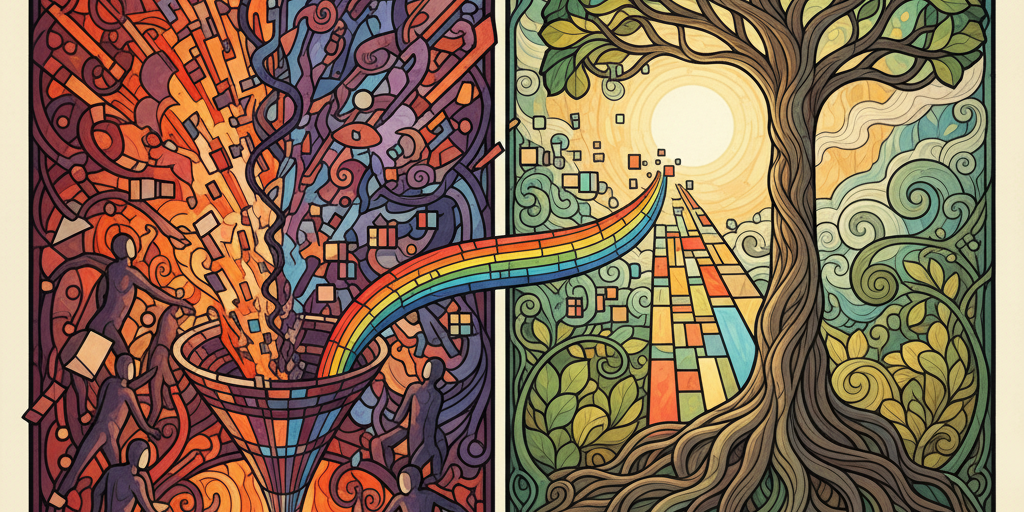
We’re culturally trained to celebrate drama. That glorification fractures teams, burns people out, and trains our hearts for scarcity. Practical reframing and incentive redesign (hiring, promotion, and daily rituals) redirect scarce attention toward steady, durable value.
Why are we programmed to chase the very things that will break us?
What are you still paying attention to while everything steady and quietly essential is quietly collapsing?
Cultural Script and Inner Conflict
We live in a culture that sells us a beautiful lie: that the greatest value lies in what is hardest to obtain. Our films and novels celebrate the chaotic, impulsive connection over the stable one, portraying reliability as boring and emotional volatility as proof of a life lived to its fullest. The brooding, unavailable partner is presented not as a red flag, but as a prize to be won.
This isn't just a story we're told; it's a script we internalise. Deep within us, a battle rages. A thoughtful, higher-level self that wants connection and truth is constantly ambushed by a primal, lower-level self, an attack dog that sees challenges as threats and scarcity as a sign of worth.
This internal conflict spills into every corner of our lives. At work, we're taught to idolise the solo superstar, the dazzling individual striving for the spotlight, while the quiet, generous collaborators who actually make the group function are treated as an afterthought, people we just stumble upon by luck, not cultivate by design. We are chasing ghosts: the partner we can "fix," the solo glory we must achieve, all while a deeper, more functional reality waits, ignored.
How the Chase Shows Up: Romance and Work
Most organisations treat brilliance like a solo contest. They hunt for the headline-maker, the visible miracle-worker, and confuse visibility with reliability. Meanwhile, the people who stitch systems together are rarely found, trained, or rewarded. I'm talking about the thoughtful coordinators, the patient connectors, the ones who show up to make other people better.
At the same time, every person in the room carries an internal tug-of-war: a deliberate, reasoning self and a reflexive, emotional self. When the reflex wins, meetings harden into postures, explanations turn into justifications, and real inquiry dies.
Add a culture that glamorises instability and you get a hiring and promotion economy that prizes scarcity and drama over steady commitment. The result is an organisation that looks exciting from the outside but is structurally fragile inside.
We are obsessed with the chase. Pop culture sells us a lie: love is a high-stakes game where the prize is the guy who’s hard to pin down. Films glorify the brooding bad boy, the emotionally distant artist, the one who needs “fixing.”
Think of Bella pining for Edward’s dangerous edge in Twilight, or Allie choosing Noah’s raw chaos over Lon’s steady hand in The Notebook. The message is clear: stability is dull, drama is destiny. We’re taught to crave the rollercoaster, those fleeting moments of connection that feel like victory because they’re so hard-won.
The result? We’re wired to confuse inconsistency with passion, to see emotional unavailability as a puzzle to solve. Every ignored text, every vague promise, hooks us deeper into a cycle that leaves us drained, questioning our worth.
This isn't a romantic chase; it's an addiction. The push-and-pull of an inconsistent partner, the thrill of being the lone hero. These things don't signal depth, they trigger dopamine. We are caught in a cycle of intermittent reinforcement, the same mechanism that makes a slot machine so compelling. We’re not in love; we're hooked.
Mechanics and Costs: Reinforcement, Loneliness, and Organisational Fragility
This constant state of uncertainty and conflict rewires our attraction to normalise dysfunction. The result is a profound, gnawing loneliness, even when we're surrounded by people. Like Andy Warhol, trapped by a belief in his own exclusion, we begin using substitutes for intimacy, collecting hollow interactions and superficial praise to fill the unbearable space between ourselves and the world.
We become unable to hear constructive disagreement without our lower-level beast getting angry, hijacking our logic. Our desperate need to be right eclipses our ability to learn what's true, and we fall tragically short of our potential, leaving a trail of emotional burnout and fractured teams in our wake.
This isn’t cosmetic. Rewarding spectacle and tolerating emotional volatility produces skewed incentives: decisions favor short-term theater, not durable outcomes; promising people burn out because they carry other people’s gaps; teams fragment into jockeying factions instead of collaborating; truth becomes a casualty of pride.
Worse, the organisation trains everyone to chase validation from intermittent reinforcement (the human version of a slot machine) and mistakes unpredictability for value. Over time, capability erodes, turnover spikes, and the system collapses not because of a single failure but because the connective tissue was never built to begin with.
This chase is costing you more than you think. Every moment spent decoding mixed signals is a moment stolen from building a life with people who shows up fully. The dopamine hit of their rare attention keeps you hooked, like a slot machine spitting out just enough coins to keep you playing.
But the stakes are higher than a bad date or a bruised ego. You’re training your heart to crave chaos over connection, to prioritise the thrill of “winning” someone over the peace of being chosen without a fight.
Relationships built on this shaky ground often crumble under the weight of unmet needs, leaving you burned out, cynical, or worse, believing this is all love can be. The real tragedy? You’re sidelining the steady, open-hearted people who don’t make you beg for their time. They’re out there, but they’re invisible to someone conditioned to chase shadows.
Escape and Practical Rewiring
The escape begins with a single, brutally simple realisation: the only people worth our time are those who don't need persuading. This applies to lovers, colleagues, and most importantly, to the warring parts of ourselves.
The breakthrough is to consciously silence the screaming, emotional beast that confuses conflict with passion and instead listen to the quiet, logical voice that recognises value in what is already present and freely given. It’s the intentional decision to celebrate a different kind of hero not the one who almost didn't make it, but the one who showed up to do a different sort of work.
It is the understanding that the brilliant ensemble player who holds the team together has chosen a more skillful path than the person fighting for the spotlight. We must stop mistaking emotional immaturity for romantic tension and defensiveness for depth.
The true turning point is when we finally stop asking, "Why don't they want me?" and start asking, "Why am I wasting my precious time trying to convince them?"
Choose different signals. Intentionally design for players who make the group better those who prioritise the whole over their spotlight. Make the higher-level self the default: reward people for being curious, for admitting ignorance, and for turning emotional reflexes into useful data.
Treat loneliness and eccentricity as information, not branding, preserve the impulse to listen and archive conversation as a practice, so quiet insight is captured rather than mythologised.
Replace scarcity-based desirability with a simple litmus test: who in your organisation shows genuine, early enthusiasm for others’ success? Those “keen” collaborators are the durable assets. Train hiring panels, promotion criteria, and daily rituals to surface and amplify them. Above all, reorient incentives so that truth-seeking beats being right, steady collaboration beats performative genius, and commitment replaces drama.
What if choosing love doesn’t have to be a battle? Imagine a world where you stop seeing emotional distance as a challenge to conquer and start seeing it as a red flag to dodge. The truth is, your brain’s been tricked. Scarcity feels like value, but it’s a lie.
Real connection isn’t about cracking someone open; it’s about finding someone already at the table, ready to meet you halfway. This isn’t about settling for “boring” or lowering your standards. It’s about redefining what’s sexy: someone who communicates who plans, who doesn’t make you wonder where you stand.
In love and business, you deserve someone who’s in it for the team, not just the spotlight. The breakthrough is simple but radical: stop chasing the ones who make you feel like an afterthought, and start valuing the ones who make you feel like the main event.
Imagine a world where your energy isn't spent on a chase, but on building. Imagine relationships that don't begin with games, but with a clear, enthusiastic conviction that matches your own.
Picture a life where love feels like a warm, steady current, not a storm you have to weather. You’re with someone who doesn’t need convincing, who’s as eager to build a future with you as you are with them.
Imagine workplaces that don't hope for linchpins but actively find, train, and reward them, creating ensembles that thrive. In this future, your focus is free for the real difficulties of life, because the battle for commitment and truth is already won. This reality is not a fantasy; it is a choice.
Imagine teams that don’t implode after a win or a loss because the work was distributed, anticipated, and held by many hands. Imagine decisions that emerge from argument curated into clarity, not ego. Imagine people who turn loneliness into listening, recording, sharing, and building from marginal voices, so innovation is a product of connection, not isolation.
Your task is to become a ruthless editor of your own life. Eject the wavering, defended, and inconsistent ones immediately. Stop mistaking their issues for your project. Hone your skill at recognising native enthusiasm and clear out everyone else.
The only worthwhile lovers, collaborators, and friends are those who never leave you wondering. They are already at the table, ready to begin. Demand this standard, and you will stop being a character in a tragedy and start becoming the architect of a masterpiece.
The payoff is immediate: less burnout, sharper outcomes, easier scaling, and talent that stays because it is seen and sustained. No more late-night overthinking, no more decoding cryptic messages. Instead, you’re free to pour your energy into shared dreams: weekend adventures, quiet mornings, or just laughing over takeout.
This is a world where your heart isn’t a battlefield but a garden, growing stronger because it’s nurtured, not neglected. You’ll look back and wonder why you ever wasted time on someone who couldn’t see your worth from the start.
Identify three roles in your organisation that are critical but invisible; change one hiring rubric to value collaborative evidence over charisma; run a single experiment this month where you reward curiosity and correction, not certainty. If you want resilience, stop worshipping drama. Reward the people who keep the machine running.
So, walk away from the ones who keep you guessing. Say no to the chase, and yes to the ones who show up, open and ready, from day one. Life’s too short for half-hearted love. Choose the ones who choose you, unapologetically, every single time.
The Essential Concepts
The Allure of Drama and Scarcity
Cultural Script and Internal Conflict: The article argues that we are culturally conditioned to chase drama and scarcity. Our films, novels, and social media idealise "hard-to-get" partners and solo superstars, teaching us to mistake emotional volatility for passion. This creates an internal conflict where a higher-level, logical self is ambushed by a primal, emotional self that confuses scarcity with worth. We end up chasing ghosts, like the partner we can "fix" or the solo glory we must achieve, while a deeper, more functional reality is ignored.
The Chase as a Dopamine Loop: This chase is not love or ambition; it's an addiction to drama. The push-and-pull of an inconsistent partner or the thrill of being a lone hero triggers dopamine, the same mechanism that makes a slot machine so compelling. We become unable to hear constructive disagreement without our ego hijacking our logic, and we fall tragically short of our potential, leaving a trail of emotional burnout and fractured teams.
The Cost of Worshipping Drama
Organisational Fragility: Organisations that reward spectacle over collaboration are structurally fragile. They hunt for the "headline-maker" and confuse visibility with reliability, ignoring the quiet, generous collaborators who actually make the group function. This leads to burnout, fragmented teams, and a system that collapses not from a single failure but because the connective tissue was never built.
Profound Loneliness: This constant state of uncertainty and conflict rewires our attraction to dysfunction. It creates a profound, gnawing loneliness even when we are surrounded by people. We become unable to hear constructive disagreement because our lower-level self sees it as a threat, which makes us tragically fall short of our potential.
The Solution: Rewiring Our Reward Systems
A New Litmus Test: The escape begins with a single, brutally simple realisation: the only people worth our time are those who don't need persuading. The breakthrough is to consciously silence the emotional beast that confuses conflict with passion and instead listen to the quiet, logical voice that recognises value in what is already present and freely given. This applies to lovers, colleagues, and most importantly, to ourselves.
A Protocol for Change: The article suggests practical steps to rewire our reward systems and focus on what truly matters.
- Ruthless Editing: Eject the wavering, defended, and inconsistent people from your life immediately. Stop mistaking their issues for your project.
- Change Hiring Rubrics: Change one hiring rubric to value collaborative evidence over charisma and reward curiosity and correction, not certainty.
- Reward Quiet Heroes: Identify three critical but invisible roles in your organisation and actively find, train, and reward the quiet collaborators and patient connectors who make the group function.
- Reject the Chase: Choose love that feels like a warm, steady current, not a storm you have to weather. Choose the ones who are already at the table, ready to begin, not the ones who keep you guessing.
I am a Knowledge Worker...
What does it mean for me?
The post warns that your career may be stuck in a chase for drama and scarcity, a pattern reinforced by a cultural script and internal conflict that mistakes emotional volatility for passion and solo brilliance for reliability.
This chase is a dopamine loop, not genuine ambition, and it leads to organisational fragility as teams fracture and the quiet, steady collaborators are ignored.
The cost is a profound loneliness and the quiet erosion of your potential.
The solution is to rewire your reward systems to value what's steady and collaborative, not what's dramatic or hard to get.
How do I action this?
- Change Your Hiring Rubric: When you are a part of a hiring process, look for tangible evidence of collaborative work rather than just charisma. Ask candidates to describe a time they helped a teammate succeed or how they navigated a disagreement with a team member. This will help you hire for durable assets, not just "superstars."
- Conduct a "Quiet Heroes" Audit: Identify three critical but invisible roles in your organisation that are often overlooked (e.g., the meticulous project manager, the patient connector, the thoughtful coordinator). Propose a new metric or a new way to recognize them to their manager.
- Reject the Chase for External Validation: For one week, consciously ignore the urge to check social media or seek external validation for your work. Instead, focus on the intrinsic value of the work itself. This will help you begin to rewire your brain to value steady, durable progress.
I am a Freelancer, Solopreneur, Entrepreneur, Independent Worker...
What does it mean for me?
The post warns that your business may be stuck in a chase for drama and scarcity, a pattern reinforced by a cultural script and internal conflict that mistakes emotional volatility for passion and solo brilliance for reliability.
This chase is a dopamine loop, not genuine ambition, and it leads to organisational fragility as your business fragments and the quiet, steady collaborators are ignored.
The cost is a profound loneliness and the quiet erosion of your potential.
The solution is to rewire your reward systems to value what's steady and collaborative, not what's dramatic or hard to get.
How do I action this?
- Ruthlessly Edit Your Network: Identify the wavering, defended, and inconsistent people in your network—the clients who can't make a decision, the collaborators who don't show up, the mentors who are always hard to reach. Immediately stop investing your time and energy in them.
- Change Your Hiring Rubric: When you are a part of a hiring process, look for tangible evidence of collaborative work rather than just charisma. Ask candidates to describe a time they helped a teammate succeed or how they navigated a disagreement with a team member. This will help you hire for durable assets, not just "superstars."
- Reject the Chase for External Validation: For one week, consciously ignore the urge to check social media or seek external validation for your work. Instead, focus on the intrinsic value of the work itself. This will help you begin to rewire your brain to value steady, durable progress.