The Second Wound: Shame, Signal Noise, and the Cost of Designed-to-Impress Systems.
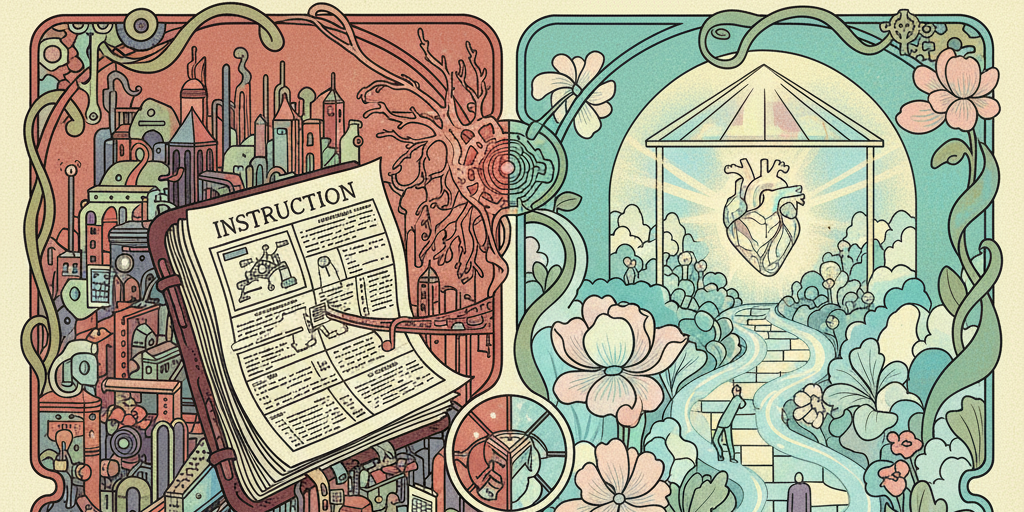
When visual polish masks brittle processes, shame multiplies and learning stalls. This piece pairs a psychological reset with a three-question experiment to test whether design actually serves.
It's a short diagnosis of how surface-level design and ancient biology create organisational drag and a compact audit to reveal whether your work is built to perform or to be admired.
Why does a difficult conversation make your heart race as if you’re being hunted by a predator?
What if everything you call “designed” exists to look clever rather than to work?
What would you do if the very tools you trust to make life easier were silently steering you away from the outcomes you truly crave?
The Biological Mismatch
We live through environments that are obsessed with being "designy." We curate the typefaces of our careers and the knurled edges of our social standing, paying homage to an aesthetic of success. Yet, beneath this polished surface, we are running software that evolution never updated. Your ancestors needed courage to keep their bodies alive; you need courage to keep your identity intact.
We are navigating modern complexities (awkward texts, underwhelming careers, digital boundaries) with a nervous system calibrated for lions. Your biology doesn't know that a "read receipt" isn't a death sentence. It interprets a threat to your belonging as an exile from the village, triggering a panic designed for the wilderness. We are trying to force a "designy" life onto an ancient, terrified biological reality, creating a friction that wears us down.
Systems That Reward Looking Good (appearance vs purpose)
We evolve inside systems that reward appearance: feature launches that win press, dashboards that impress bosses, processes ornamented with hand-polished details nobody needs. The visible craftsmanship, the typefaces, the tiny bevels, the “innovative” extras, signal competence even when outcomes lag.
Teams justify choices with ambition or awards, not with clarity about who benefits, what success looks like, and which constraints actually matter. Because few answer those three questions honestly, projects ship with latent fragility: brittle automations, meetings that replicate themselves, and products that confuse rather than serve.
Beneath that operational noise sits another force, the ancient nervous system trying to protect belonging, so people mute real objections and call it professionalism.
You scroll, you click, you follow the polished interfaces that promise simplicity. An app’s sleek icon, a perfectly spaced menu, a glossy ad campaign each tells you, “We’ve designed this for you.” Yet the design you see often never translates into real value.
We mistake appearance for purpose. When a product looks good, we assume it works well, and we stop asking who it’s for, what it’s meant to achieve, and which constraints shape it. The result? Hours wasted on tools that reinforce habits rather than liberate ambition, and a quiet erosion of agency as the systems we rely on dictate the rhythm of our day.
The Human Cost: Shame, Silence and the Performance Loop
The tragedy isn't the fear itself; it's the shame that follows. We inflict a "second wound" upon ourselves: the shame of small fears. A voice inside berates us, asking why we are so pathetic when others have it worse. We try to brute-force a solution using the standard way of learning: criticism and command.
We judge our past behaviour, shout internal orders to "be better," and try to muscle our way into confidence. This is "Self 1" taking over. A vicious cycle of judgment that interferes with our natural capability.
We struggle against the laws of reality, and as Ray Dalio notes, reality penalises things that do not work well. By fighting our own nature with shame, we detract from our own evolution, leaving us exhausted and stuck in a loop of performative anxiety.
That mismatch wastes time and capital, but the damage is deeper and cumulative. Customers tolerate friction once, twice, and then churn. Engineers maintain clever hacks that rearrange problems instead of solving them. Decision-makers praise “clever” work while systemic value decays.
On the human side, small fears (fear of saying no, fear of being seen as wrong) compound into chronic silence. We shame ourselves for being anxious about what are, objectively, minor threats, which creates a second wound: guilt layered on genuine unease. The result is predictable: slower learning, brittle strategies, and an organisational culture that confuses noise for progress.
Every missed deadline, every half‑finished idea, every lingering doubt about “doing it right” compounds into a silent tax on your confidence. The brain’s ancient alarm system wired for predators fires on modern anxieties: a notification ping, a poorly phrased email, a mis‑aligned KPI.
The cost isn’t just lost productivity; it’s the growing shame of feeling “small” for fearing a glowing rectangle, the self‑critique that tells you you should be grateful because “others had it worse.” That inner critic becomes a loop: criticise, command, struggle, judge, repeat. It drains energy, stalls learning, and keeps you trapped in a cycle where the tool feels like the master, not the servant.
The Inner Game and Design Commitments (framework for change)
To become truly "well-designed", where we stop noticing the effort and simply achieve the outcome, we must align with the laws of reality. The breakthrough lies in the "inner game." We must stop the shouting commands and start with nonjudgmental observation.
We have to admit what the design is actually for. Is this career designed to win an award or to accomplish a purpose? Is this behaviour designed to get buzz, or to create a shared goal?
Instead of forcing correction, we must visualise the desired outcome and trust "Self 2" to execute. We observe the fear, that ancient reaction to a modern rustle in the dark, without attaching a value judgment to it. We see the biology for what it is, not what we think it should be.
Change begins with three commitments: declare who you serve, define what success looks like for them, and state the constraints you accept. When those answers guide every choice, design stops being an exercise in aesthetic signaling and becomes an instrument of purpose. Build against reality: if something does not operate consistently with how the world actually works or fails to add to the ecosystem you depend on, it will be penalised.
Finally, treat honesty as a muscle. Shrink the perceived cost of small acts of courage so people stop converting every minor fear into silence.
Imagine stepping back and observing your workflow without judgment. Just pure awareness of what actually happens. Picture the desired outcome as a vivid scene: a project completed with clarity, a conversation that ends in mutual understanding, a creative spark that flows uninterrupted.
Now, let that image guide you. Trust the part of you that learns intuitively and stop micromanaging every click. Align each tool with a clear purpose: define who benefits, what success looks like, and the real constraints you face. When a design truly serves its purpose, its fingerprints fade into the background, leaving only the results you intended.
Vision and Practical Application
When you stop fighting reality, you unlock a new, quieter form of valour. Modern bravery isn't about swinging an axe at a visible monster; it's about telling the truth gently. It is the courage to walk away from a life that looks good on paper, "designy" and purely aesthetic, for one that feels right in your chest.
By replacing judgment with observation, you contribute to the evolution of the whole, creating a life that is finally coherent. You become capable of the hardest acts of the modern age: saying no, ending the wrong friendship, and admitting you want more.
Start today by answering the honest questions: Who is this life for, and what is it for? Observe your fear, drop the judgment, and design a reality that actually works.
Imagine products, meetings, and automations that are unremarkable because they simply work: fewer support tickets, clearer metrics, and decisions that compound advantage instead of consuming it.
Imagine teams that surface problems early because speaking up is safe and expected. The payoff is practical and measurable (reduced rework, higher retention, faster learning) and humane: less shame, more clarity, less wasted courage.
Take one concrete step now: run a 30-minute “Three Questions + One Experiment” audit.
- Convene the smallest decision-making group (up to five people).
- Answer, out loud and in one sentence each: Who is this for? What is the single outcome we care about? Which constraint will we accept?
- Choose one tiny experiment that tests whether the work contributes to the whole (one metric, one week).
- Observe without judgment, record what changed, and repeat.
If you do this once, you’ll expose whether your systems are truly designed or merely designed to be admired. Be generous with the people who feel fear; the nervous system’s alarm is not proof of weakness. Start with honesty, protect the experiment, and let reality, not reputation, decide what survives.
Picture a workspace where every app, every interface, every habit is a deliberate extension of your goals, not a hidden agenda. Projects launch on time because the tools amplify, not obstruct, your vision.
Conversations flow because you’ve trained your nervous system to treat a message on a screen the same way it once treated a warning bark, recognising the signal without the panic.
Your learning accelerates: you observe, visualise, and let your inner competence take the lead, breaking free from the endless self‑critique loop. You reclaim the joy of creation, the confidence to set boundaries, and the courage to speak truthfully, even when the world offers no applause.
Start today by picking one “designy” tool you use daily. Write down: Who benefits from it, what outcome you truly need, and which constraint matters most. Then test a single adjustment that aligns the tool with that purpose. Observe the shift. Repeat for the next tool. Let the cumulative effect rewrite the story of your work and your life.
The Essential Concepts
Biological Mismatch and the "Second Wound"
We are running evolutionary software that hasn't been updated for the digital age, leading to a profound mismatch between our reactions and our reality.
- Lions vs. Read Receipts: Our nervous systems are calibrated for wilderness survival. Consequently, a "read receipt" or an awkward text is interpreted as a threat to our belonging—the equivalent of being exiled from the tribe. Your biology doesn't know that a digital slight isn't a death sentence.
- The Second Wound: The tragedy isn't the initial fear; it’s the shame we feel for having that fear. We judge our anxiety as "pathetic," creating a second wound of guilt. This triggers an internal cycle of criticism and command that interferes with our natural competence.
- Appearance vs. Purpose: We prioritise "designy" aesthetics—perfect typefaces, sleek menus, and polished dashboards—over actual utility. We assume that if something looks good, it works well, which stops us from asking if the system actually serves a human purpose.
The Inner Game of Design
To escape the performance loop, we must move away from "Self 1" (the judging, shouting internal critic) and align with the laws of reality through "Self 2" (the intuitive, natural doer).
- Nonjudgmental Observation: Instead of forcing correction through shame, observe your behaviour and your fear without attaching a value judgment. See the biology for what it is—a "rustle in the dark"—rather than what you think it should be.
- Visualising Outcome: Stop shouting commands at yourself. Form a crisp mental image of the desired outcome and trust your intuitive competence to execute the "Inner Game."
- Honesty as a Muscle: Modern bravery is the courage to tell the truth gently and walk away from things that look good on paper but feel wrong in your chest. We must shrink the cost of small acts of courage so they don't convert into silence.
The 30-Minute "Purpose Over Performance" Audit
To determine if your systems are truly designed or merely designed to be admired, execute this surgical audit today:
- The Smallest Group: Convene a decision-making group of no more than five people.
- The Three Questions: Answer these three questions out loud in one sentence each:
- Who is this for? (Declare exactly who you serve).
- What is the single outcome we care about? (Define what success looks like for the user).
- Which constraint will we accept? (State the reality you are building against).
- The One-Week Experiment: Choose one tiny, measurable experiment to test if the work actually contributes to the outcome.
- Observe and Repeat: Record what changed without judgment. If the design fails to add to the ecosystem, let reality—not reputation—decide its fate.
I am a Knowledge Worker...
What does it mean for me?
In the corporate world, you are likely navigating a Biological Mismatch: using an ancient nervous system designed for Lions vs. Read Receipts to manage digital hierarchies and Slack pings.
When you feel a spike of panic over a blunt email from a manager, your biology is misinterpreting a threat to your professional belonging as a threat to your actual survival.
This leads to the Second Wound—the toxic layer of shame where you berate yourself for being "anxious" or "weak." This internal judgment empowers Self 1 (the shouting critic) to take over, causing you to prioritise Appearance vs. Purpose.
You likely spend hours polishing "designy" dashboards and decks to signal competence to the tribe, even when those systems don't move the needle.
This performance loop creates a "silent tax" on your confidence and results in Systemic Rot, where projects are designed to be admired by bosses rather than to function in reality.
To grow, you must move from "shouting commands" at yourself to Nonjudgmental Observation, treating your biological reactions as neutral data and realigning your work with actual outcomes instead of aesthetic signaling.
How do I action this?
- Execute a Personal "Three Questions" Audit: Apply this to your most time-consuming recurring task. Ask: Who is this for? (a specific stakeholder), What is the single outcome? (the one change in reality this task achieves), and Which constraint will I accept? (e.g., "I will spend only 60 minutes on the slides"). This forces a shift from "looking clever" to "working well."
- Practice Nonjudgmental Observation of Triggers: The next time you feel a "second wound" of shame after a stressful digital interaction, stop the internal critique. Observe the physical sensation (racing heart, tight chest) and label it: "This is my ancient biology reacting to a modern signal." By removing the judgment, you allow Self 2 to stay online and handle the situation with intuitive competence.
- Form a Crisp Mental Image Before High-Stakes Tasks: Before a difficult meeting or presentation, stop the "Self 1" verbal instructions ("Don't stutter," "Be impressive"). Instead, close your eyes and visualise a vivid image of the desired outcome—yourself speaking clearly and the audience nodding in understanding. Trust the Inner Game of your subconscious to execute that image.
- Exercise Honesty as a Muscle: Identify one "designy" process in your workflow that serves no purpose other than looking good. Propose a tiny experiment to your team to simplify or remove it for one week. This small act of courage reduces the cost of silence and helps align your team's efforts with reality rather than reputation.
I am a Freelancer, Solopreneur, Entrepreneur, Independent Worker...
What does it mean for me?
As an independent, you are particularly vulnerable to the Appearance vs. Purpose trap because your brand is your identity.
You may obsess over "designy" aesthetics—perfect fonts, landing pages, and social media knurling—while your core business processes remain brittle.
This is often an Identity Shield fueled by the Biological Mismatch; you fear that a "unpolished" launch is a death sentence for your reputation.
When things don't go perfectly, you inflict the Second Wound on yourself, using shame as a motivational tool, which only serves to choke your natural creativity.
Business sustainability requires moving into the Inner Game of Design. You must stop being the "Insecure Coach" who micromanages every click and instead start with Nonjudgmental Observation of your market and your own habits.
True bravery for an indie hacker or freelancer isn't about working harder; it’s the courage to walk away from a "glossy" strategy that isn't producing the single outcome you care about.
By aligning your tools and habits with the laws of reality, you stop "performing" success and start building a system that achieves it.
How do I action this?
- Run the 30-Minute "Purpose Over Performance" Audit: Gather your "smallest group" (even if just yourself and a trusted peer) to scrutinise your lead product. Answer: Who is this for?, What is the outcome?, and Which constraint will we accept? Write these in one sentence each to strip away the "aesthetic signaling" that is draining your capital and time.
- Launch a One-Week "Reality Test" Experiment: Identify the most "polished" part of your sales funnel. Run an experiment that strips back the aesthetic and focuses purely on the outcome (e.g., a plain-text email vs. a heavily designed HTML template). Observe the results without judgment; let reality decide which version survives, not your desire to look clever.
- Shrink the Cost of Small Acts of Courage: Commit to one "unpolished" action today—post a raw thought, send an imperfect pitch, or admit a limitation to a client. By lowering the stakes of being seen as "less than perfect," you stop the Second Wound from paralysing your progress and rebuild your relationship with effort.
- Use the "Vivid Image" Shift for Creative Block: When you feel stuck in a loop of self-critique, stop "shouting" at yourself to be creative. Shift your focus to a vivid mental image of the finished product being used by a happy customer. Trust your natural competence (Self 2) to guide your hands toward that outcome without the friction of "Self 1" interference.